
 English

Arm float life jackets are popular flotation products for children learning to swim or playing in the water. They are designed to provide additional buoyancy around a child's upper body and arms, helping children stay more stable while they develop basic swimming skills. However, parents and buyers often ask an important question: Are arm float life jackets safe for kids?
The short answer is that an arm float life jacket can provide useful flotation support when it is properly designed, correctly fitted, and used under constant adult supervision. However, it should not be treated as a replacement for a properly certified life jacket or active supervision. Understanding the product's design, fit, buoyancy, materials, and intended use is essential when choosing a flotation product for children.
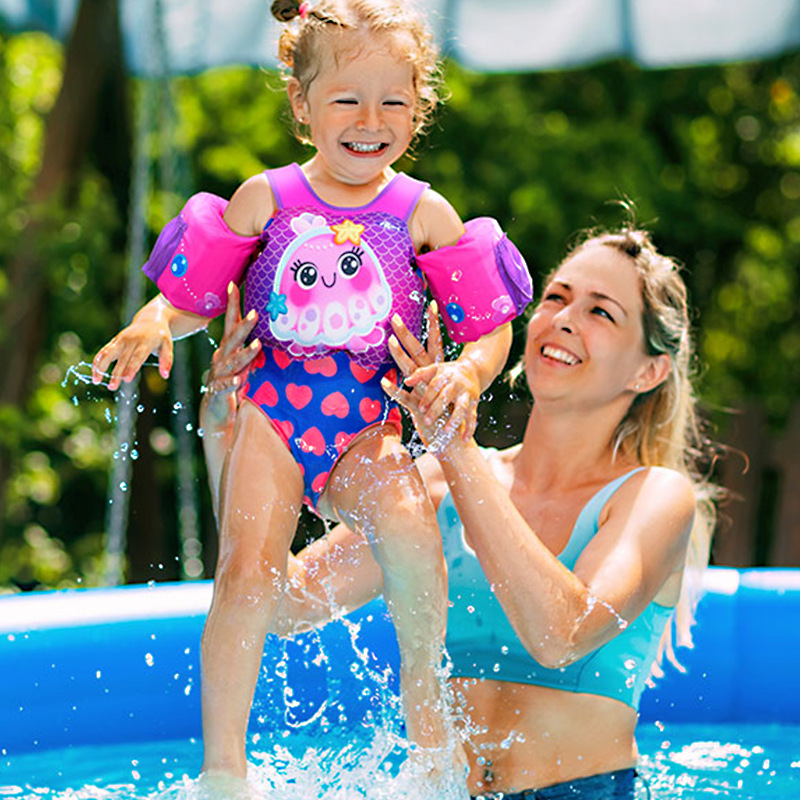
What Is an Arm Float Life Jacket?
An arm float life jacket is a children's flotation product that combines features of traditional arm floats with additional flotation support around the child's upper body. Depending on the design, it may include inflatable arm chambers, a buoyant body section, adjustable straps, buckles, or other positioning features.
Unlike simple inflatable arm floaties, some arm float life jackets are designed to provide a more stable fit and reduce the possibility of the flotation device slipping away from the child's arms during normal water activities.
Because designs vary significantly between manufacturers, parents should always check the product's intended age range, weight range, buoyancy information, and safety instructions before use.
How Does an Arm Float Life Jacket Help Children?
The primary purpose of an arm float life jacket is to provide additional buoyancy and support while a child is in the water. For children who are learning to swim, this additional flotation may help them feel more comfortable and confident while practicing basic movements.
Depending on the design, an arm float life jacket may help support the child's upper body and arms while allowing the legs to move more freely. This can be useful during supervised swimming lessons, recreational pool activities, and other appropriate water environments.
However, flotation equipment should be viewed as a support tool rather than a guarantee of safety. A child can still become tired, lose balance, or move into an unsafe position while wearing a flotation product.
Are Arm Float Life Jackets Safe for Kids?
Arm float life jackets can be safe for kids when they are appropriate for the child's size, properly fitted, used according to the manufacturer's instructions, and combined with close adult supervision.
Safety depends on several factors rather than the product name alone. Parents should consider the child's age, weight, swimming ability, water conditions, product construction, and the specific purpose for which the flotation device was designed.
It is also important to understand that not every product marketed as an "arm float life jacket" is a certified personal flotation device. Parents should check whether the product meets the applicable safety standards for the intended market and whether it is approved for the specific activity.
Arm Float Life Jacket vs. Arm Floaties
Arm floaties are generally simple inflatable flotation devices worn around a child's arms. They are commonly used as swimming aids and may help provide buoyancy during supervised recreational activities.
An arm float life jacket may incorporate additional design elements, such as a body flotation section, adjustable straps, secure buckles, or other features intended to improve positioning and fit.
| Feature | Arm Floaties | Arm Float Life Jacket |
|---|---|---|
| Primary purpose | Flotation support | Flotation support with additional positioning features depending on design |
| Coverage | Primarily the arms | Arms and, depending on design, part of the torso |
| Adjustability | Usually limited | May include adjustable straps or buckles |
| Best suited for | Supervised water play and swimming practice | Supervised swimming practice and recreational water activities, depending on the product |
The important point is that these products should not automatically be considered equivalent to certified life jackets. Parents should evaluate the actual product specifications and certifications rather than relying only on the product name.
What Should Parents Check Before Buying an Arm Float Life Jacket?
1. Choose the Correct Size
A proper fit is one of the most important considerations. An arm float life jacket that is too loose may shift or move during use, while one that is too tight may cause discomfort and restrict movement.
Parents should check the manufacturer's recommended weight, age, chest size, or other sizing information. The flotation device should fit securely without creating excessive pressure around the child's arms or body.
2. Check the Buoyancy Design
Different flotation products provide different levels and distributions of buoyancy. Parents should understand where the flotation material is located and how it is intended to support the child in the water.
A well-designed children's flotation product should provide predictable buoyancy appropriate for its intended use. Product information should clearly explain the recommended user range and application.
3. Look for Secure Straps and Fasteners
For products with straps or buckles, check whether they can be adjusted securely and whether the fastening system is easy to use. The device should remain properly positioned during normal movement in the water.
For children's flotation products, durable buckles, reinforced seams, and reliable fastening components can contribute to long-term product performance.
4. Consider the Materials
Materials are particularly important for children's products because they are exposed to water, sunlight, chlorine, salt water, and repeated use.
Manufacturers may use materials such as PVC, EVA foam, neoprene, or other buoyant materials depending on the product design. Buyers should consider durability, comfort, skin contact, water resistance, and the intended environment when evaluating materials.
5. Check Applicable Safety Standards
Safety requirements vary by country, market, and product category. A flotation aid intended for recreational swimming may have different requirements from a certified personal flotation device.
Before purchasing, parents should check the product's labeling, instructions, testing information, and applicable certifications. For international buyers, manufacturers and suppliers should be able to provide relevant compliance documentation for the target market when applicable.
Can Toddlers Use Arm Float Life Jackets?
Toddlers may use certain flotation products specifically designed for their size and developmental stage, but parents should pay particular attention to fit, buoyancy, and intended use.
A flotation product should never be selected simply because it is marketed for children. The product's recommended weight and age range should match the child. Toddlers also require particularly close supervision because they may not understand water hazards or be able to respond appropriately if they lose balance.
For very young children or non-swimmers, parents should follow guidance from qualified swimming instructors and local water-safety authorities when choosing appropriate flotation equipment.
Are Arm Float Life Jackets Suitable for Swimming Lessons?
They can be useful as swimming aids in some supervised learning situations, depending on the child's swimming level and the instructor's approach.
Flotation equipment can help beginners become familiar with being in the water. However, children should also gradually develop independent swimming and water-survival skills rather than becoming completely dependent on flotation equipment.
Swimming instructors may use different flotation aids at different stages of learning. Parents should therefore follow the recommendations of the instructor and choose equipment that matches the learning objective.
Why Adult Supervision Is Still Essential
One of the most important safety principles is that a flotation device does not replace adult supervision.
Children can still fall, become exhausted, move into deeper water, or encounter unexpected water conditions while wearing flotation equipment. An arm float life jacket can provide flotation support, but it cannot monitor the child's surroundings or prevent every water-related accident.
Adults should remain close enough to respond quickly and should pay continuous attention to the child rather than relying on the flotation device as the primary safety measure.
How to Use an Arm Float Life Jacket Safely
Check the product before every use. Look for punctures, leaks, damaged seams, broken buckles, or other visible defects.
Choose the correct size. Follow the manufacturer's recommended age and weight range.
Fit the product correctly. Adjust straps and fasteners according to the manufacturer's instructions.
Test the fit in shallow water. Make sure the product remains properly positioned before moving into deeper water.
Maintain close adult supervision. Never assume that flotation equipment makes unsupervised swimming safe.
Use the product only for its intended purpose. Do not use a swimming aid as a substitute for a certified life jacket when a certified life jacket is required.
Store the product properly. Keep it dry and away from excessive heat, sharp objects, and prolonged direct sunlight when not in use.
What Makes a Good Arm Float Life Jacket for Kids?
For parents and buyers, a good children's arm float life jacket should combine appropriate buoyancy, comfortable materials, secure fitting, durable construction, and clear usage instructions.
For manufacturers and wholesale buyers, product consistency is equally important. A reliable arm float life jacket manufacturer should be able to provide information about materials, production processes, product testing, quality control, packaging, and applicable compliance requirements.
For brands selling children's swimming products, additional considerations may include custom colors, logo printing, packaging design, OEM production, private labeling, and different size options.
So, are arm float life jackets safe for kids? They can be a useful flotation aid when the product is appropriately designed, correctly fitted, used for its intended purpose, and combined with continuous adult supervision.
Parents should not judge safety based only on the term "arm float life jacket." Instead, they should evaluate the product's size, buoyancy, materials, construction, instructions, testing, and applicable safety standards.
For swimming lessons and recreational water activities, the right flotation product can provide useful support while children develop their water skills. However, proper supervision and swimming education remain essential parts of children's water safety.
FAQ
Are arm float life jackets the same as life jackets?
Not necessarily. Some products are flotation aids rather than certified personal flotation devices. Always check the product's certification, labeling, and intended use before relying on it for safety.
Can a child swim independently with an arm float life jacket?
A flotation device should not be considered proof that a child can swim independently. Children should remain supervised and should develop appropriate swimming and water-safety skills.
What age can children use arm float life jackets?
The appropriate age depends on the specific product. Parents should follow the manufacturer's recommended age, weight, and size range rather than choosing a product based only on age.
Are inflatable arm float life jackets safe?
Inflatable flotation products can be useful when they are properly designed, maintained, fitted, and used under supervision. They should be checked for leaks or damage before each use.
What should I look for when buying an arm float life jacket?
Consider the child's size, buoyancy requirements, product construction, materials, fit, fastening system, testing or certification, intended use, and manufacturer's instructions. For wholesale purchasing, buyers should also evaluate quality control, production capacity, customization options, and compliance documentation.